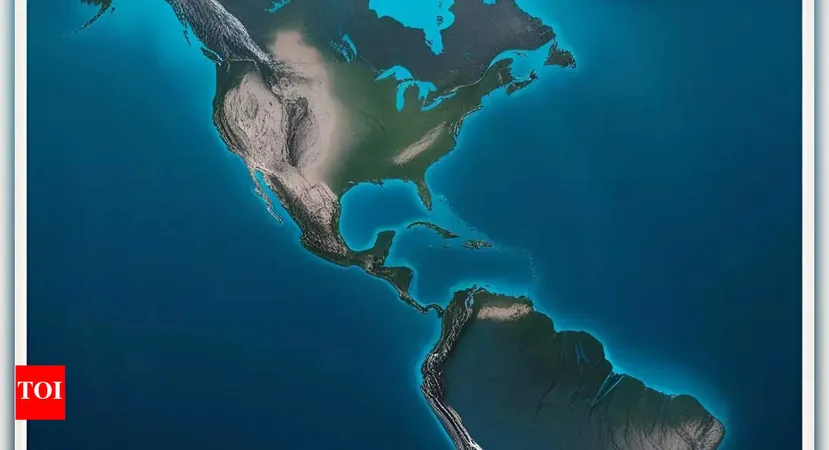
Unveiling Greenland's Hidden Continent: The Davis Strait Proto-Microcontinent
2025-04-18
Author: Jia
A Groundbreaking Discovery Beneath the Ice
Prepare to be amazed! Scientists have uncovered a long-lost fragment of a continent hiding beneath the vast ice sheets of Greenland. Dubbed the "Davis Strait proto-microcontinent," this hidden landmass is reshaping our understanding of the North Atlantic's geology. This incredible finding also illuminates the mysteries of plate tectonics and continental drift.
How Did This Microcontinent Come to Be?
The Davis Strait proto-microcontinent dates back tens of millions of years, believed to be part of a tectonic rift system that once linked Greenland with Canada. During the Paleogene period, from around 61 to 33 million years ago, tectonic forces began to tear apart the Earth's crust in this region, leading to rifting and the formation of the ocean floor.
An Isolated Crust Beneath Ocean Waves
Researchers discovered this ancient landmass lies approximately 19-24 kilometers deep beneath the ocean floor. Surprisingly, it was never fully separated from the adjacent landmasses, making it an intriguing example of a "stranded" continent.
Uncovering the Tectonic Secrets
Using cutting-edge gravity mapping and seismic imaging, scientists revealed the structure and fault orientations of the area. They pinpointed a pivotal shift in seafloor spreading that occurred around 49 to 58 million years ago, transitioning from a northeast-southwest to a north-south direction, crucially influencing the proto-microcontinent's original placement.
The Final Collision and Its Impact
This fascinating saga reached its climax when oceanic spreading ceased around 33 million years ago. Greenland then collided with Ellesmere Island, becoming part of the North American plate and sealing the fate of the proto-microcontinent beneath the Arctic waters.
A Window into Earth's Tectonic Past
In a groundbreaking study published in Gondwana Research, researchers including Fr. Jordan Phethean and doctoral students from the University of Derby highlighted that the isolated tectonic history of this area makes it a prime location for studying microcontinent formation. These regions, described as being part of thicker continental lithosphere surrounded by thinner zones, could provide critical insights into the Earth's surface evolution well into the future.
 Brasil (PT)
 Canada (EN)
 Chile (ES)
 Česko (CS)
 대한민국 (KO)
 España (ES)
 France (FR)
 Hong Kong (EN)
 Italia (IT)
 日本 (JA)
 Magyarország (HU)
 Norge (NO)
 Polska (PL)
 Schweiz (DE)
 Singapore (EN)
 Sverige (SV)
 Suomi (FI)
 Türkiye (TR)
 الإمارات العربية المتحدة (AR)