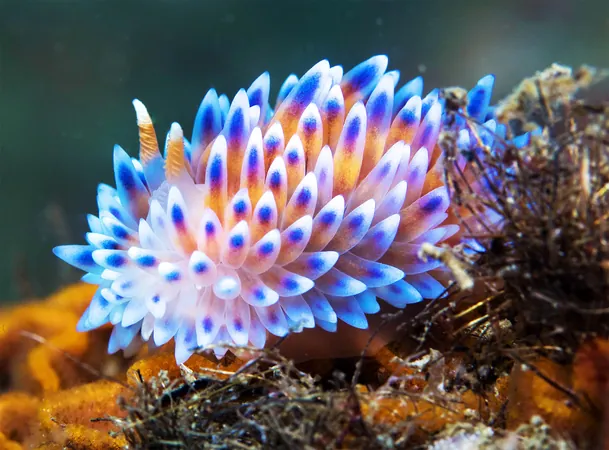
Unveiling the Dazzling Secrets of Sea Slugs: Nature's Vibrant Protectors!
2025-04-24
Author: Jia
Tiny Yet Magnificent: The Alluring World of Sea Slugs
Sea slugs, also known as nudibranchs, might be small, but their stunning colors and shapes make them some of the ocean's most captivating inhabitants. Surprisingly, while many creatures shroud themselves in secrecy, these colorful creatures flaunt their vibrant patterns in broad daylight, warning predators to think twice before approaching.
The Science Behind the Dazzling Display
A recent study led by Dr. Cedric van den Berg from the University of Queensland delved into the aesthetics of these fascinating sea dwellers. By examining 45 distinct species, the research team discovered that the slugs’ bright patterns play a crucial role in deterring predators, particularly fish equipped with trichromatic vision.
Colorful Warnings: A Predatory Game of Avoidance
According to Dr. van den Berg, these sea slugs utilize stunning color contrasts to send a concise message: 'Don’t eat me, I’m poisonous!' This bold approach—known as aposematism—means that the brighter the hue, the less likely they are to end up as a meal. Many slugs employ bold stripes or spots delineating their potential toxicity, which becomes even more pronounced under the sun's rays.
By Day or By Night: Strategic Camouflage
While daytime slugs shine bright to warn off predators, their nocturnal counterparts exhibit subtler patterns to avoid detection. The study highlighted how certain slugs switch tactics based on whether they are active during the day or night, relying on their surroundings to enhance their survival.
Learning How Light Shapes Survival Strategies
Using advanced imaging techniques, researchers simulated how these patterns are perceived by fish, discovering that a quick flash of color can make fish reconsider a potential feast. With around 90% accuracy in predicting slugs' daytime behavior, the research illuminates the relationship between appearance and activity.
The Chemistry of Color: Nature's Toxic Palette
Beyond their striking exteriors, some sea slugs protect themselves with potent chemicals that can injure or taste unpleasant to would-be predators. However, not all slugs possess these defenses; some utilize camouflage instead, blending seamlessly with their environment.
The Future of Sea Slugs Amid Changing Oceans
As oceanic conditions evolve due to climate change, the effectiveness of these vibrant warnings may also shift. Researchers are keen to uncover how changes in light levels or the decline of fish populations might impact the survival of these stunning sea creatures.
A Dance of Color and Survival in the Sea
These trials highlight a delicate balance for nudibranchs: they must be colorful enough to send a warning, yet not too bold to tempt a predatory taste test. Understanding their visual signals can shed light on broader ecological dynamics and the intricate web of life beneath the waves.
Sea slugs remind us that even the smallest creatures can wield remarkable defenses and strategies, captivating our imaginations while serving as a stark reminder of nature's astounding beauty.
 Brasil (PT)
 Canada (EN)
 Chile (ES)
 Česko (CS)
 대한민국 (KO)
 España (ES)
 France (FR)
 Hong Kong (EN)
 Italia (IT)
 日本 (JA)
 Magyarország (HU)
 Norge (NO)
 Polska (PL)
 Schweiz (DE)
 Singapore (EN)
 Sverige (SV)
 Suomi (FI)
 Türkiye (TR)
 الإمارات العربية المتحدة (AR)