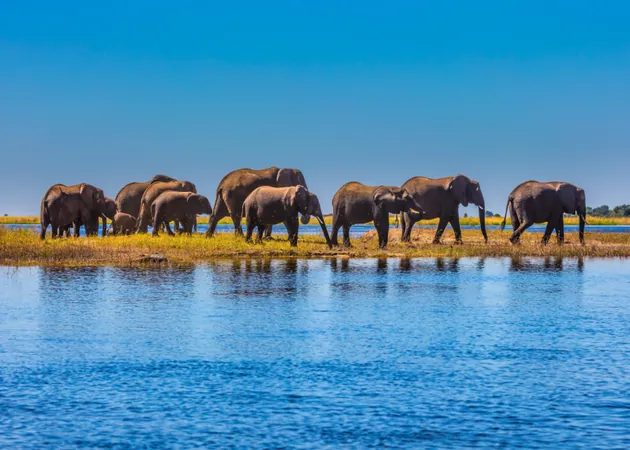
Unveiling the Hidden Link: How Earth's Mantle Shaped the Evolution of Elephants, Giraffes, and Humans
2025-04-18
Author: Wei Ling
The Untold Story Beneath Our Feet
What lies below the Earth's surface might seem distant, but the activity there plays a pivotal role in shaping continents, influencing ocean currents, climate patterns, and even the course of animal evolution. New research suggests that a plume of molten rock, which erupted from the Earth's mantle millions of years ago, significantly influenced the journey of early ancestors of elephants, giraffes, and humans to Asia and Africa.
A Remarkable Discovery
In a groundbreaking study published in Nature Reviews Earth & Environment, a team of international scientists delves into the creation of a vast land bridge that emerged 20 million years ago, connecting Asia and Africa through regions now known as the Arabian Peninsula and Anatolia. This research melds previous findings with innovative models developed at The University of Texas at Austin's Jackson School of Geosciences and the GFZ Helmholtz Centre for Geosciences.
The Great Uplift: A New Era for Animal Migration
The gradual rise of land allowed ancient animals, from giraffes to humans, to freely traverse between Africa and Asia, effectively ending a 75-million-year isolation of Africa from other continents. As Thorsten Becker, a co-author of the study and a professor at the Jackson School, notes, this research prompts vital questions about how changes on our planet connect with the evolution of life.
How It All Began
The tale unfolds 50-60 million years ago when a tectonic slab sank into the mantle, creating a 'conveyor belt' that propelled hot rocks upward, culminating in a plume that reached the surface 30 million years later. This geological activity, combined with colliding tectonic plates, led to significant land uplift, which played a crucial role in closing the ancient Tethys Sea and forming a landmass that bridged Asia and Africa.
A Perfect Timing for Evolution
Eivind Straume, the lead author of the study, highlights the far-reaching implications of this geological activity. He emphasizes that the emergence of the land bridge and the evolution of various species occurred in sync. "If the continents had collided even a million years later, the evolutionary paths of animals migrating between Africa and Asia could have taken entirely different turns, affecting even our own human ancestors," he explained.
Re-Colonization and Evolutionary Shifts
Several million years prior to the complete closure of the land bridge, primate ancestors of modern humans migrated from Asia into Africa. Although the Asian lineages eventually went extinct, they diversified in Africa. Once the land bridge was fully formed, these primates returned to Asia, showcasing the interplay between geological and biological evolution.
More Than Just Animal Movement
The emergence of the Arabian Peninsula also triggered significant climatic shifts. Researchers found that the warming of nearby ocean temperatures altered seasonal temperature ranges, transforming large tracts of land from North Africa to Central Asia into more arid environments. This shift is believed to have played a crucial role in the Sahara's evolution into a desert, while enhancing monsoon seasons in Southeast Asia.
A Comprehensive Narrative
This research brings together diverse fields, including plate tectonics, evolutionary anthropology, and climate studies, to paint a cohesive picture of how mantle dynamics have influenced life on Earth. Becker concludes, "This summary of recent advancements may be provocative, but it compellingly illustrates the interconnectedness of our planet's geological and biological evolution."

 Brasil (PT)
 Canada (EN)
 Chile (ES)
 Česko (CS)
 대한민국 (KO)
 España (ES)
 France (FR)
 Hong Kong (EN)
 Italia (IT)
 日本 (JA)
 Magyarország (HU)
 Norge (NO)
 Polska (PL)
 Schweiz (DE)
 Singapore (EN)
 Sverige (SV)
 Suomi (FI)
 Türkiye (TR)
 الإمارات العربية المتحدة (AR)