Unveiling the Secrets of the Caribbean's Ant Masters
2025-04-21
Author: Sarah
A Fossil of Extraordinary Significance
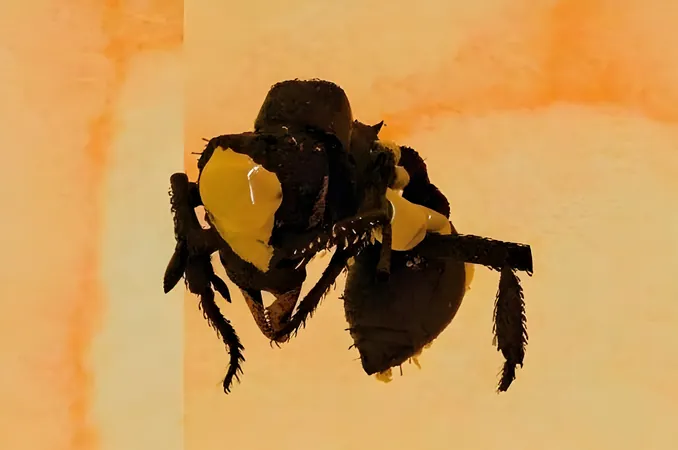
Scientists have unearthed an incredible 16-million-year-old ant fossil from Dominican amber, shedding new light on a rarely seen group known as dirt ants, or Basiceros. This remarkable find introduces Basiceros enana, a previously unknown species that roamed the Caribbean long ago before vanishing during the Miocene epoch.
The Discovery that Shifts Evolutionary Understanding
Gianpiero Fiorentino, leading the study as a PhD candidate at the New Jersey Institute of Technology (NJIT), expressed the thrill of discovering such an elusive species. "Finding a dirt ant today is exciting, but capturing one in amber is like finding a diamond," he said. This fossil is unlike any modern relative, potentially redefining our understanding of Basiceros' evolutionary journey.
Questions Arise About Ant Habitats
Traditionally, dirt ants have only been recognized in the neotropical rainforests from Costa Rica to southern Brazil, with only nine living species documented. The existence of B. enana raises intriguing questions regarding how these ants might have spread and settled across the Caribbean islands.
Advanced Techniques for Uncovering the Past
To delve deeper into the evolution of this ancient ant, researchers used cutting-edge imaging techniques, such as Micro-CT scanning at NJIT and the Okinawa Institute of Science and Technology. This innovative technology has allowed for detailed 3D reconstructions of the fossil, uncovering features otherwise not visible, which aided in tracing its lineage.
The Smallest Ant in History?
At only 5.13 millimeters long, B. enana is the tiniest recorded member of its genus — significantly smaller than its modern cousins, which can reach nearly 9 millimeters. Fiorentino pointed out that this discovery flips previous assumptions on their heads, revealing that dirt ants actually grew larger over millions of years.
Ancient Adaptations and Modern Camouflage
Despite its diminutive size, B. enana showcased some advanced adaptations, including
an impressive form of camouflage known as crypsis. It possessed specialized hairs designed to trap dirt and debris, which would have helped it blend seamlessly into its environment.
A Funeral for the Caribbean's Dirt Ants?
The extinction of Basiceros ants from the Caribbean likely resulted from significant environmental changes during the Miocene. Researchers propose that ancient land bridges may have once connected these islands to mainland South America, facilitating the ants’ migration.
Competition and Loss of Diversity
Fiorentino noted that the decline of dirt ant populations might have been due to competition for resources. "Caribbean ecosystems have seen a loss of predatory ant diversity, with over a third of ant genera vanishing from the modern Dominican Republic since amber's formation," he stated, underscoring the need to understand these patterns to combat modern extinction threats.
Exploring a Larger Evolutionary Puzzle
This unique fossil provides critical insights into what drives extinction among some species while others persist through the ages. The study, published in the prestigious Proceedings of the Royal Society B, opens new pathways for future research into biodiversity and conservation.
With ancient secrets locked in amber, the journey to uncover the mysteries of the past continues.

 Brasil (PT)
 Canada (EN)
 Chile (ES)
 Česko (CS)
 대한민국 (KO)
 España (ES)
 France (FR)
 Hong Kong (EN)
 Italia (IT)
 日本 (JA)
 Magyarország (HU)
 Norge (NO)
 Polska (PL)
 Schweiz (DE)
 Singapore (EN)
 Sverige (SV)
 Suomi (FI)
 Türkiye (TR)
 الإمارات العربية المتحدة (AR)