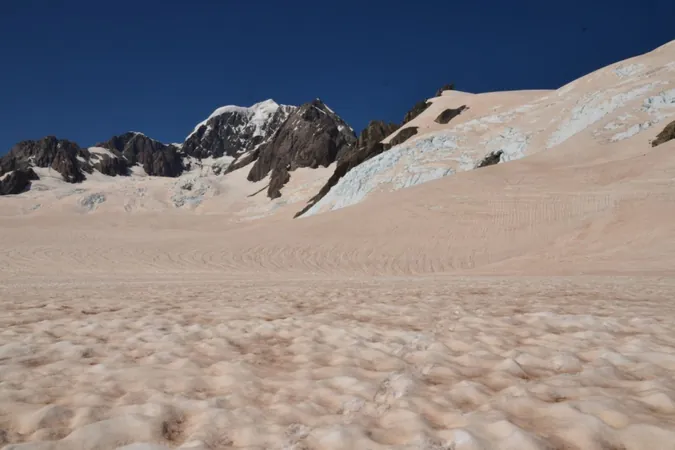
Why New Zealand's Alps Were Painted Red: The Shocking Truth Revealed!
2025-04-24
Author: Ming
Mystery Unraveled: The Alarming Red Transformation
During the Southern Hemisphere's summer of 2019-2020, New Zealand's majestic Southern Alps underwent a shocking transformation, emerging in a vivid shade of red. New research finally sheds light on this startling phenomenon.
The Unexpected Culprit Behind the Red Snow
Far from the ashes of Australia's devastating bushfires, it turns out that the vibrant red hue was caused by a massive dust storm from southeastern Australia, unleashing around 4,500 tons of red dust onto the icy peaks. This revelation was detailed in a groundbreaking study published last December in the journal Geophysical Research Letters.
Debunking Misconceptions: The Real Timeline of Events
Holly Winton, the lead author and environmental scientist at Te Herenga Waka—Victoria University of Wellington, clarified that initial media reports wrongly linked the red mountains to ash from bushfires. In reality, the dust plumes hit the Southern Alps well before New Year’s Eve, arriving instead in late November 2019.
The Science Behind the Color Change
Utilizing time-lapse cameras, air mass tracking, and remote sensing, Winton and her team meticulously traced the origins of the contamination. They found that the fresh snowfall that followed quickly buried the dust, only for it to re-emerge when the snow melted in early 2020, coinciding with the dramatic visuals of the bushfire calamities.
Dust, Climate Change, and Alarming Implications
The study warns that the layers of dust absorbed sunlight, diminishing the snow's reflective qualities and contributing to accelerated melting. Co-author Phil Novis, a phycologist from Manaaki Whenua Landcare Research, expressed concern that climate change is likely to increase desertification and the frequency of such dust storms, as well as wildfires, in the years to come.
A Call to Action: Understanding Environmental Impact
This dust event is not just a solitary anomaly; it's the ninth recorded incident of its kind in New Zealand since 1902 and one of the most dramatic. The study serves as a stark reminder of the less visible consequences of climate change, urging leaders to take decisive action to address these environmental challenges.

 Brasil (PT)
 Canada (EN)
 Chile (ES)
 Česko (CS)
 대한민국 (KO)
 España (ES)
 France (FR)
 Hong Kong (EN)
 Italia (IT)
 日本 (JA)
 Magyarország (HU)
 Norge (NO)
 Polska (PL)
 Schweiz (DE)
 Singapore (EN)
 Sverige (SV)
 Suomi (FI)
 Türkiye (TR)
 الإمارات العربية المتحدة (AR)