Why Some People Become Disease 'Superspreaders': The Surprising Role of Exhaled Droplets
2025-04-22
Author: John Tan
Unlocking the Mystery of Superspreaders
A groundbreaking study conducted by a team of infectious disease experts and environmental engineers from France and Italy has shed light on an intriguing phenomenon in disease transmission—superspreaders. These individuals seem to infect many more people than average, and researchers believe the answer lies in the droplets they expel while exhaling.
The Study That Changed Everything
Published in the esteemed journal Physical Review Fluids, the study involved 23 adult volunteers who participated in three key activities: breathing normally, speaking, and coughing. The researchers closely monitored the physical characteristics of the droplets released during these activities.
Droplets: The Invisible Culprits
It's well-known that infectious diseases often spread through tiny droplets expelled from the mouth and nose. These minuscule particles can linger in the air long enough for others to inhale and become infected. However, the study highlighted significant variability in droplet characteristics across individuals. This variability may very well be a contributing factor to why some individuals are identified as superspreaders.
Measuring Droplet Dynamics with Precision
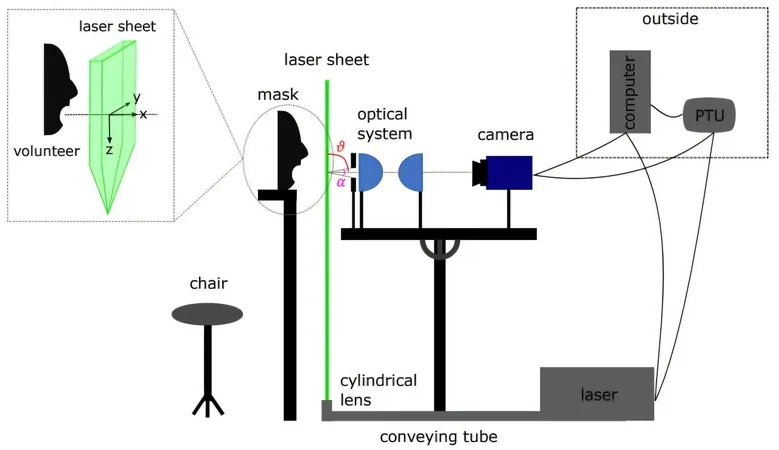
Using advanced technology, including a laser sheet and high-speed cameras, researchers quantified droplet size and speed during the participants' exhalations. They found that droplet sizes when speaking or coughing ranged from 2 to a staggering 60 micrometers, while normal breathing produced droplets averaging between 2 and 8 micrometers.
The Effects of Coughing and Masks
Coughing was observed to propel droplets farther and faster, resulting in higher concentrations in the air. Interestingly, normal breathing caused more drifting of droplets than either speaking or coughing. Additionally, the study revealed that wearing masks dramatically reduced droplet emission, blocking between 74% and 86% of them.
Understanding Variability for Future Protection
What truly stood out was the variation in droplet characteristics, not only between different individuals but also in repeated tests of the same person. This inconsistency underscores the potential for distinct droplet profiles to help identify and explain the behavior of superspreaders.
Implications for Public Health Practices
These findings could be pivotal in shaping public health policies, particularly in terms of masking, social distancing, and understanding the dynamics of disease spread. By delving deeper into the mechanics of exhaled droplets, researchers hope to develop more effective strategies to combat infectious diseases.

 Brasil (PT)
 Canada (EN)
 Chile (ES)
 Česko (CS)
 대한민국 (KO)
 España (ES)
 France (FR)
 Hong Kong (EN)
 Italia (IT)
 日本 (JA)
 Magyarország (HU)
 Norge (NO)
 Polska (PL)
 Schweiz (DE)
 Singapore (EN)
 Sverige (SV)
 Suomi (FI)
 Türkiye (TR)
 الإمارات العربية المتحدة (AR)